
 Follow on Google
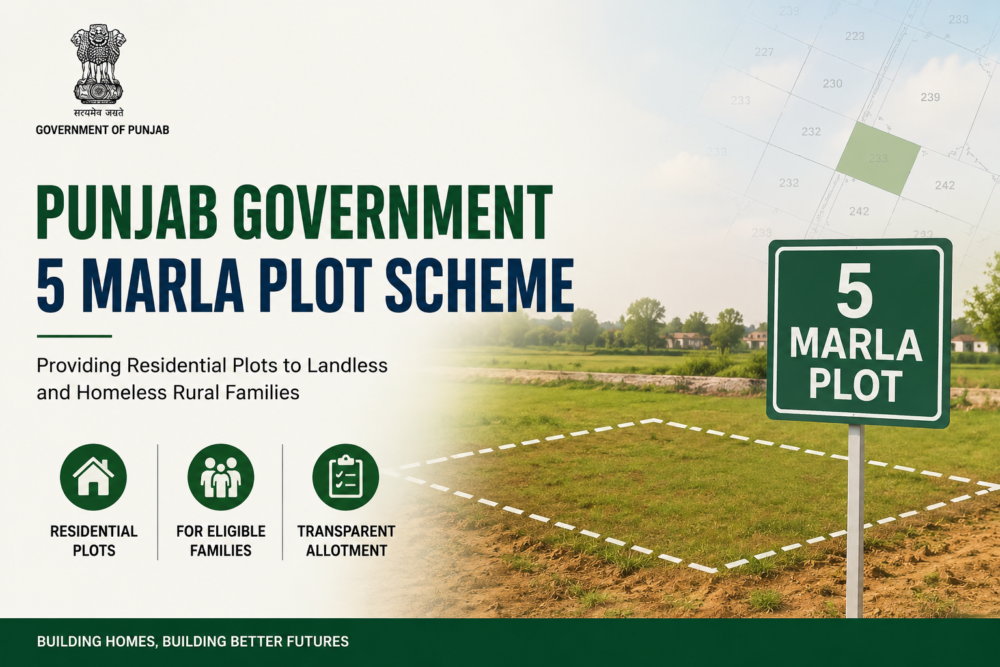
For a landless or houseless family in Punjab, securing even a modest plot of land marks the initial move towards securing a permanent home. But under the Punjab Govt 5 Marla Plot Scheme, what’s relevant is the state’s policy framework regarding allotment of small residential plots to eligible landless or houseless families, typically at the village level or gram panchayat level.
However, there is an important distinction in 2026: the 5-marla plot provision should not be confused with a newly launched statewide online application scheme. The underlying policy has existed for years, while actual plot allotment is subject to eligibility, identification of beneficiaries and approval by relevant authorities.
What Is the Punjab 5 Marla Plot Scheme?
As per Rule 13-A of the Punjab Village Common Lands (Regulation) Rules, Gram Panchayats can allot residential plots to landless workers and houseless families from Shamlat Deh land eligible for residential use. This can only be done after obtaining prior approval from the government.
According to a Punjab & Haryana High Court decision, the government put in place a policy back in 2001 to grant eligible people a free plot of land measuring up to 5 marlas. They can use this residential plot to construct a house. This policy was amended from time to time and eligibility was extended to some Backward Class families as well.
Essentially, the goal is to provide residential land to eligible families who neither own a house nor land to construct a new house.
Who Can Be Eligible?
Here are some of the eligibility criteria for this Punjab policy, as outlined in court records:
- The applicant needs to be a resident of the relevant Gram Sabha.
- The beneficiary cannot own a house or land to build a house.
- The beneficiary must be married.
- The policy initially included only houseless Scheduled Castes, Rai Sikh and Christian beneficiaries. Backward Class families were included at a later date when the policy was amended.
Keep in mind that these are just eligibility criteria. Identified beneficiaries will still have to go through an application process.
How Is a 5 Marla Plot Allotted?
The allotment process is linked with your local Gram Panchayat and district administration, instead of applying as an individual online.
Officially, the procedure we found recorded on the government Punjab portal states that the Gram Panchayat “discovers” eligible beneficiaries in a Gram Sabha meeting and passes a resolution for the proposal to be approved. It can go through the Block Development and Panchayat Officer, District Development and Panchayat Officer before the “competent authority” in the district makes the final decision.
That’s why hopeful applicants are advised to first contact your Gram Panchayat or relevant rural development officers before trusting websites that promise everyone can register online right now for a “2026 5 Marla Plot Scheme”.
Is the Scheme Currently Open for Online Applications?
We were unable to find an official Government of Punjab notification communicating a new opening for online applications across Punjab under the scheme title “Punjab 5 Marla Plot Scheme 2026”, as of August 2026.
The official Punjab portal is where the government posts official government notifications and department services, while the separate eServices Punjab portal is where Punjab citizens can access online government services.
This means applicants should cross-check any application link, date, fee or list of beneficiaries with your concerned Gram Panchayat, Block office, District administration or official Government of Punjab online portal before giving out personal information or paying fees to anyone.
What About 5-Marla Plots in Urban Areas?
You’ll find “5-Marla Plot” listed as a specific category within Punjab’s official urban planning and development documentation. However, this doesn’t always mean it refers to the free government-allotment scheme you might be searching for.
The Punjab planning authorities use 5-marla residential plots as a category in zoning maps that include specific size dimensions and building guidelines.
City residential schemes, PUDA/GMADA housing projects, rehabilitation settlements, and rural Gram Panchayat registrations can therefore have entirely different criteria and costs.
Final Takeaway
The Punjab 5 Marla Plot Scheme generates genuine anticipation, as it’s a recognized initiative with a history rooted in established policy and law. But most of these websites make it sound like a new scheme that anyone can start registering for online in 2026.
To get accurate details, you should connect with your Gram Panchayat and local district authorities to find out if your village has any land set aside, is currently choosing recipients, or has already decided who gets a plot.
You can also follow the Government of Punjab portal for official announcements.